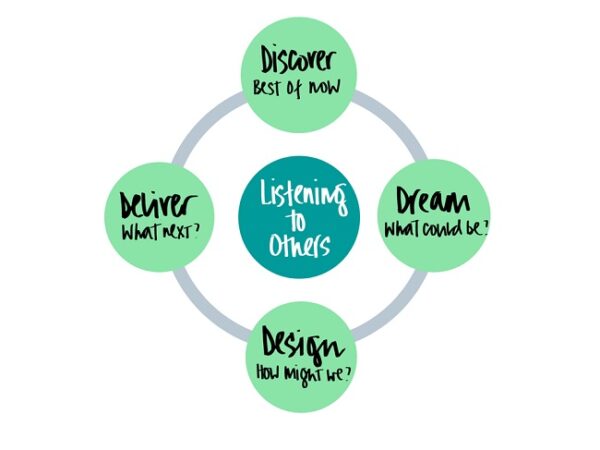
The thinking behind Appreciative Inquiry is simple; the people are the organisation. How you engage and enthral them will, as we have already seen, have a direct impact on many important factors, which in turn impact on the people around you and their sense of purpose and well-being.
Processes don’t do work, people do. As we know from the research in ‘How Full is your Bucket’ the more positive the environment, the greater the levels of engagement and well-being.
Whether you are in an ascribed leadership role or not, asking questions and being really curious about what’s working is a different way to approach change and to solve problems.
On the final workshop in the programme you will have an opportunity to experience an Appreciative Inquiry which will result in Change Prototypes.
The following section provides overview information on some of the underpinning thinking and tools that can be used at each stage.
To begin, watch these two videos and make some notes.
Powerful Questions
We know that questions are more transformative than answers and are essential tools of engagement. Questions create the space for something new to emerge. However, in the busy world of task, target, fix it and sort it, answers are still valued more than questions and, in the short-term, often feel easier.
Answers, especially those that respond to our need for quick results, while satisfying, shut down the discussion, and the future shuts down with them.
What can make us impatient with questions and hungry for answers is that in organisational life there is confusion between the process of exploring a question and ‘talking shop’. The latter has no meaning and leads to an ego-based argument, analysis, explanation and defensive behaviour. The former creates space for new thinking to emerge.
Useful for
- Preparing for conversations that you want to be different
- Identifying the ‘heart’ of what you want to inquire about
- Defining patterns of questions for events, conversations with teams or one-to-ones
Resources: Powerful Questions
Empathy Journeys
Empathy journeys are conducted to enable us as peer leaders and change-makers to really understand the thoughts, feelings and experiences of others. This is strongly linked to the development of excellent powerful questions and the work around levels of listening and rules of engagement.
Empathy journeys find out what is going on for people in the system, they get underneath titles and dismantle assumptions through genuine inquiry and listening. These empathy journeys can take many formats, from a one-to-one conversation to intensive shadowing to graphic recording and films.
Whatever the methodology, the purpose remains the same to discover what you can’t see and feel.