If there was ever any doubt about the importance of a peer leader’s ability to navigate change, uncertainty, and disruption, the emergence of the global pandemic in 2020 made this necessity abundantly clear. And while we all hope to avoid future pandemics, one thing is certain — we cannot avoid ever-increasing complexity.
The peer leaders we work with often report feeling stuck, ill-equipped or overwhelmed as they face the growing challenges of their roles. Understandably, it’s easy to feel this way when the complexity of our world has surpassed our “complexity of mind,” as Robert Kegan and Lisa Lahey describe in their book, Immunity to Change. To put this in concrete terms, computing power has increased more than a trillion-fold since the mid-1950s, but our brains remain unchanged.
To effectively lead others in increasing complexity, peer leaders must first learn to lead themselves. Although each peer leader faces their own unique circumstances, we have observed six strategies that accelerate your ability to continually learn, evolve, and navigate progressively more complex challenges.
Everything that you have learned on the Personal Leadership part of the programme is helpful here.
Victoria Grady identifies 3 attitudes/behaviours that can help peer leaders lead others through change: Choice. Connection to Purpose and Bridge. Read her easy guide here:
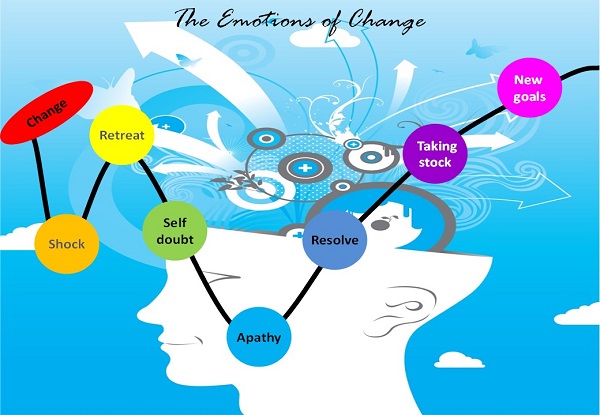
Emotions of Change
The Change Curve is a popular and powerful model used to understand the stages of personal transition and system change. It helps you to think about how people might respond to change. Experience, patterns of behaviour and current emotional state underpin how people will respond to change. So, understanding the differences in behaviours and emotional responses can help peer leaders and change makers respond appropriately by looking to get the best from people.
It’s important to remember that these are ‘normal’ and ‘natural’ responses to change, and it’s only the part of getting stuck in the unhelpful states that should be any cause for concern.
What does this mean for peer leaders?
The following section provides some tips and hints that can help at each of the stages in the change curve. These are ideas only and should not be seen as a must-do or cure-all; each situation is different and unique, and everything that we have learned so far in this book can be of value in the right place.
Shock
The verbal communication may be non-existent or aggressive and confrontational. The behaviours that accompany shock are firmly in the emotional zone and may be happening subconsciously.
No matter what is happening for individuals here, it may not be what it seems. It is important not to get hooked into the behaviour. Use questioning to find out where the individual(s) are really coming from and what you can do to support and help them. Lots of listening and not too much talking.
Retreat
The word describes what may be happening for people, a withdrawal, verbally and even physically. Limited verbal communication, internalising of the situation and events.
Team members/individuals are no good to you as a leader if they are not making a contribution. You need to find ways to bring them back from the outside through empathy, encouragement, and inquiry really listen to the answers and challenge where appropriate.
Self-Doubt
Change brings concern and fear. This naturally gets people to box themselves into a corner where they decide what is going to happen and that there may not be a place for them in the new whatever. Many of the behaviours from the retreat are still likely to be evident at this stage, however, it is important to recognise that self-doubt sometimes presents as overconfidence.
Paint the picture for individuals of what the future will look like and the role that you see them playing in that future. Confirm successes and achievements. Provide small incremental milestones for individuals and the team and be proactive with feedback to provide an impetus towards continuous improvement.
Apathy
Apathetic people are around in the workplace anyway, with or without change. Recent studies show that around 20% of people in the UK are actively disengaged at work. You will know whether the apathy is unusual and due to the change or just part of the “character” of the individual. This is typified by a “don’t care” attitude, a lack of teamwork and generally a lack of personal responsibility and is self-centred. Often leaders spend lots of time and energy with individuals who are in apathy, which often creates time management pressures and resentment from the rest of the team who are trying to get on with things.
Make sure that you are clear that the person is in apathy and not self-doubt, as the strategies for dealing with these are different. Engagement through reference to previous successes and a good Discovery question can help.
Resolve
At this stage, the behaviour is more positive than it has been up to this time. Even if the feeling is “we have no choice but to get on with it”, there is a definite feeling of movement here that doesn’t exist in the previous stages. This presents itself as physical and emotional change as people begin to get on, get going, go with the flow and make a start.
This is the time for the leader to capture the change in mood and set out the vision, influence each individual appropriately and energise the moving forward that has begun. Set out the importance of everyone’s contribution, providing structure and guidance around requirements and communication.
Taking Stock
The next logical stage from resolve and likely to follow on. An analytical and problem-solving area likely to be accompanied by lots of discussions and questions, reflections and predictions.
This is an important time to keep the team with you, it is easy to lose people, and they can slip back into the Self-Doubt/Apathy/Resolve Bermuda Triangle! Lots of listening to their ideas and perceptions, a different perspective now can often save a lot of time, energy and team hassle later on. Remember that everyone is entitled to contribute to the vision; otherwise, how will they own it and begin to feel passionate about it?
New Goals
Here are the exciting beginnings of planning to deal with the change. Team members may not all necessarily be delighted, proactive and dynamic about the change, and there will still be traces of the “because we have to” attitude. Enthusiasm may run away with itself, and initial excitement may soon wane.
Watch out for the ‘bench sitters’, the ‘underminers’, and the ‘we’ve done this before’ brigade. Give these people important roles and monitor them closely! Make the best use of the team, delegate to strengths, agree ground rules for communication, action planning and feedback.
Systems Change
‘Continuing to do what we are currently doing but doing it harder or smarter is not likely to produce very different outcomes. Real change starts with recognizing that we are part of the systems we seek to change. The fear and distrust we seek to remedy also exist within us – as do the anger, sorrow, doubt, and frustration. Our actions will not become more effective until we shift the nature of the awareness and thinking behind the actions.’
— Senge, Hamilton and Kania
Systems change is inherently an “inner” and “outer” process or journey. This work involves deep shifts in mental models, relationships, and taken-for-granted ways of operating as much as it involves shifts in organisational roles and formal structures, metrics and performance management, and goals and policies. Because of this, we believe that the development of self is foundational.
This inner work – which involves developing awareness, compassion, understanding, and wisdom – is part of what you have been working on in the early parts of the programme when you reflected on your Transactional Analysis, Strengths and the interview with your line manager. This section of the toolbox extends that thinking to how to create the conditions for successful systems change.
Inner Change Journey
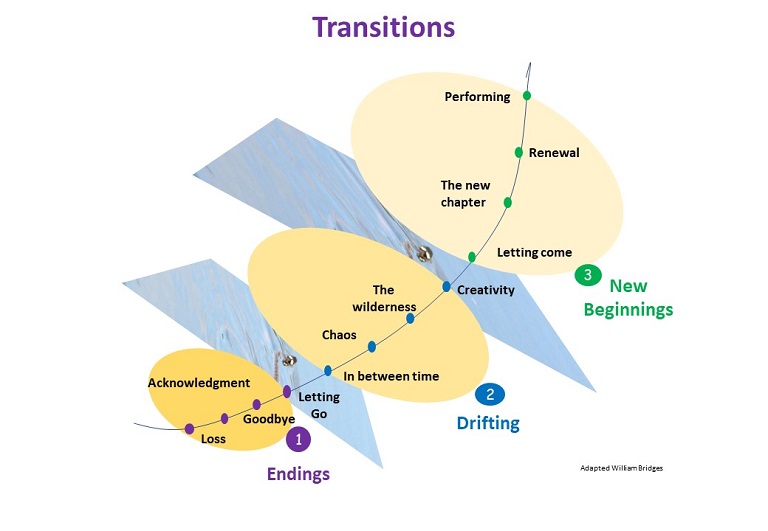
William Bridges spent his life helping people and organisations to ‘transition’ through change. The fundamentals of his thinking are laid out below.
Change is the external event or situation that takes place: a new business strategy, a turn of leadership, a merger or a new product. The organisation focuses on the desired outcome that the change will produce, which is generally in response to external events. Change can happen very quickly.
Transition is the inner psychological process that people go through as they internalise and come to terms with the new situation that the change brings about. Empathetic leaders recognise that change can put people in crisis. The starting point for dealing with transition is not the outcome but the endings that people have in leaving the old situation behind.
Change will only be successful if leaders and organisations address the transition that people experience during change. Supporting people through transition, rather than pushing forward, is essential if the change is to work as planned. This is key to capitalising on opportunities for innovation and creating organisational resilience.
From a systems perspective, it makes sense that the system is also transitioning. Endings may be traditional and conventional processes being changed, hierarchies being flattened, and budgets being reduced. Beginnings may be new ways of working, more enabling structures and a complete rethinking of how we do things around here.
A Systems Focus: Theory U
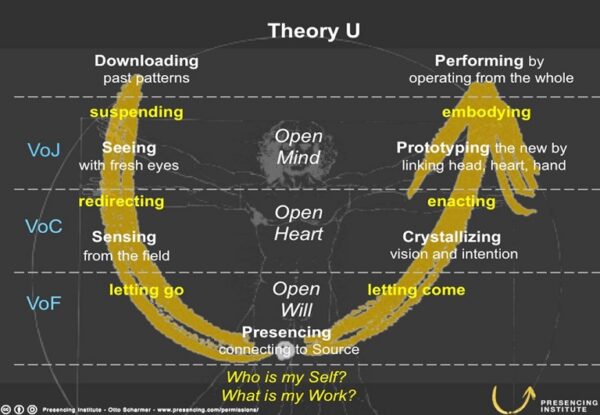
Theory U is change philosophy and process co-created by Otto Scharmer and his colleagues at the Presencing Institute https://www.presencing.org and the Massachusetts Institute of Technology.
Building upon two decades of action research at MIT, the process shows how individuals, teams, organisations and large systems can build the essential leadership capacities needed to address the root causes of today’s social, environmental, and spiritual challenges. It differs from most change methodologies because it does not predetermine the endpoint.
It uses a human-centred approach to letting go of ego and embracing eco. This just means making it about the whole system and not just about you or your part of the system. This way of engaging with change considers disconnects and blind spots across the system as well as mining potential and opportunity.
Everything we are learning with Covid 19 is reinforcing just how critical this kind of approach is and what can happen when we forget about the wider, bigger impact.
The journey through the U requires leadership from everyone. Not just hierarchical leaders, everyone acting as a leader for the whole system.
This requires specific leadership behaviours, which Otto describes as 7 Leadership Capacities:
- Holding the Space of Listening: to self and to others, suspending judgment and the call to action
- Observing: looking with fresh eyes
- Sensing: seeing the system from the edges by seeking out the views and experiences you don’t have
- Presencing: connecting deeply to self and the system
- Crystallising: creating shared purpose, energy and intention
- Prototyping: manifesting all of the thinking, emotion and ideas visibly, testing change
- Co-evolving: a roadmap to scaling change and embedding new thinking and behaving
Reflective Practice
- Planning a different and more integrated approach to change
- Challenging everyone to be engaged in conversations about letting go and letting come
- Using as a framework for leadership conversations
Helpful additional information
Watch a simple animated introduction to Theory U.